
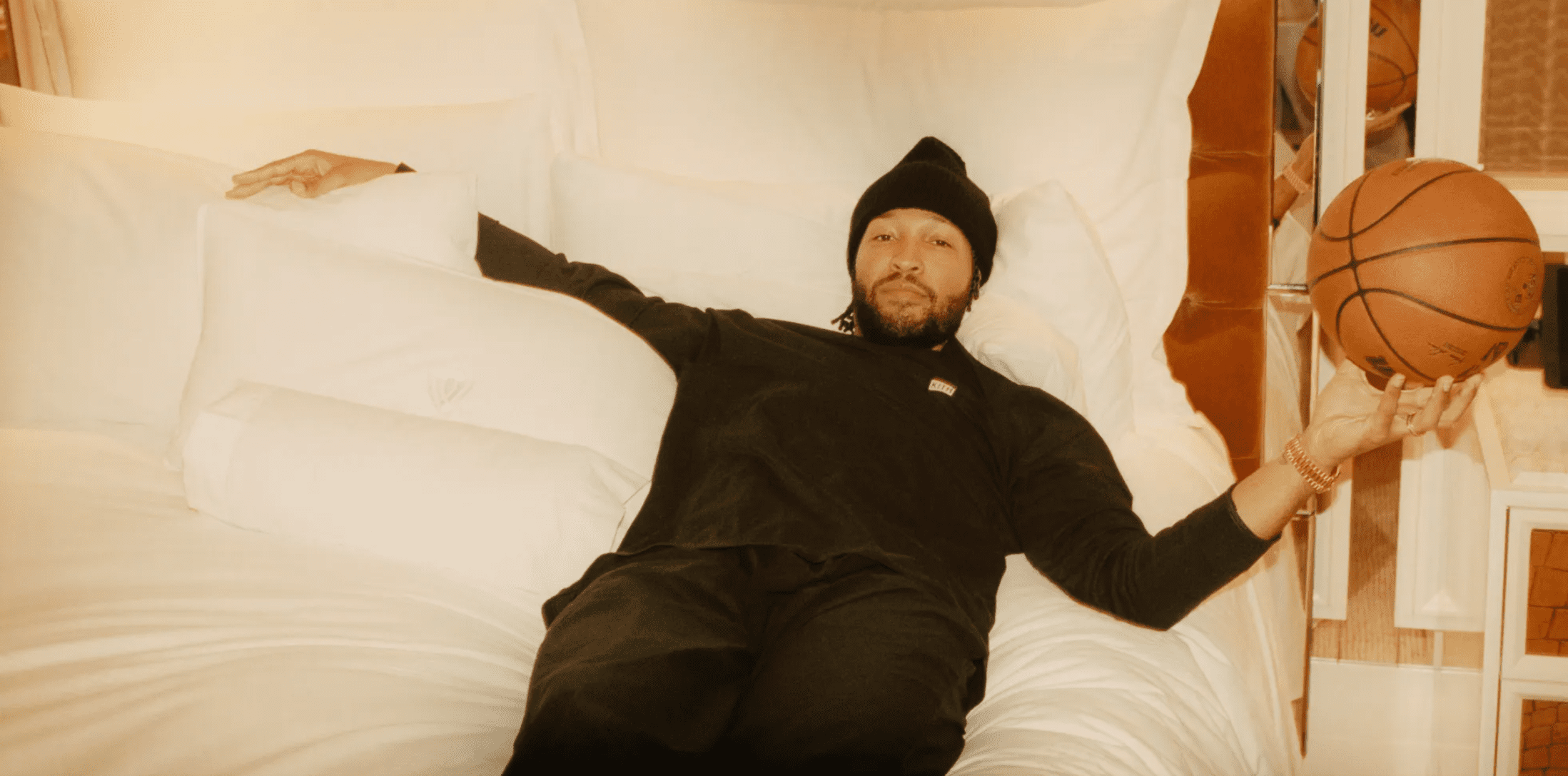
The Triumphant, Transformational Power of Jalen Brunson
FEBRUARY 17, 2026 | VANITYFAIR.COM
The Triumphant, Transformational Power of Jalen Brunson
In his four seasons leading the Knicks, New York’s most beloved athlete has restored the city’s belief in the possibility of its first NBA championship since the ’70s.
NEW YORK — Jalen Brunson sips his chamomile tea and ponders a question that still feels strange to ask:
Are the New York Knicks good enough to win it all?
Brunson, the team’s captain and unquestioned star, does not exactly sound like someone planning a ticker tape parade.
“We got a lot of work to do,” he says, his voice taking on the stern register of a concerned parent.
Brunson speaks carefully, as if weighing how candid to be. He mentions the Knicks’ uneven road record and laments a lack of sharpness on the margins. Then he pauses, collects his thoughts, and offers what feels like a sobering assessment of a team that, at the time, sits only a few games out of first place.
“We’re very gifted. We’re very talented,” Brunson says. “But we need the little things that help us be better, the intangibles. We got to that point last year where we had it. We don’t have it right now.”
Brunson lives by an unforgiving standard, one that propelled his rise and reset expectations for what he and the Knicks can achieve. Currently in his fourth season with the team, Brunson stands as the city’s most beloved athlete of the moment. Both the Post and the Times, in rare bipartisan alignment, have anointed him the “King of New York,” while his number 11 jersey has become a kind of civic uniform across the five boroughs. Fans of all ages swarm for autographs and selfies—or maybe just to say thanks—whenever he braves the hordes of Manhattan. He even garnered 27 write-in votes in last year’s mayoral election (29 if you include the ballots that misspelled his name) and earned a shout-out in Zohran Mamdani’s inauguration speech. In a city full of naysayers, Brunson somehow appears to have none at all.
“He’s been the perfect guy to come to New York,” says Ben Stiller, a lifelong Knicks fan.
That sentiment has more to do with substance than showmanship. The Jalen Brunson experience is not characterized by flash, and he has achieved rock star status without ever acting like one. A crafty southpaw, Brunson has an “old man game,” one built on deft footwork, a soft touch around the basket, pump fakes, and post-ups. He is a prolific scorer, but his highlight reel is perhaps not quite as scintillating as one featuring, say, Anthony Edwards.
Brunson’s playing style, all efficiency and economy, mirrors his understated demeanor; his father once quipped that his son is “boring as shit to interview.” His low-key vibe may seem off-brand for a New York icon, but Brunson’s improbable journey to stardom and workmanlike approach have endeared him to the city like few others.
“He’s always been an underdog,” Stiller says. “New Yorkers love that.”
Most of all, though, they love Brunson for the central role he’s played in the Knicks’ renaissance, transforming the team from a byword for dysfunction into one typified by competence. “He has completely changed the perception and direction of a single franchise and he’s done it in New York, which is not easy to do,” says Mike Breen, the longtime ESPN play-by-play announcer and voice of Knicks broadcasts. “He’s in the conversation [to be] one of the greatest Knicks of all time, and he’s done it in three plus years.”
Mamdani, with signature rhetorical flourish, describes Brunson as “every New Yorker who’s been told that they are not enough, but has proven that the greatness of this city belongs to all of us.”
“Jalen Brunson was never supposed to be a superstar, and that’s what makes him ours,” Mamdani adds. “He found in New York a place he could call home, and came to match the greatness of the city he wears across his chest. He is one of us.”
The sun shines brighter over Madison Square Garden these days, especially during the playoffs, when long-dormant expectation creeps back in. Those moments have a way of revealing players, and Brunson has won over fans by routinely rising to them—a quality that gives him an edge in the local hierarchy over Aaron Judge, the Herculean Yankees slugger with an unfortunate habit of saving his worst performances for October. (Judge, for what it’s worth, received just 11 write-in votes for mayor.) Last season Brunson was named the NBA’s Clutch Player of the Year, which he later backed up with a smooth game-winning three to eliminate the Detroit Pistons in the first round of the playoffs. Stiller, like a true diehard, still revisits that play from time to time.
“There’s something about the guy that has affected more than just winning,” says Stiller. “His personality, his story, his work ethic—all of that is so perfectly New York.”
Having the Knicks back in contention feels just as right. New York—home of Rucker Park, proving ground for Kareem, point guard holy land—is a basketball town, and one of the sport’s true capitals. Brunson has restored that patrimony, bringing the roar back to the Garden in April and May. After winning just one playoff series in the two decades before his arrival, the Knicks have advanced past the first round in each of the last three. Last year Brunson took them further than they’ve been in a quarter century, reaching the conference finals for the first time since Bill Clinton was president. When the Knicks go on a run like that, New York feels smaller, shrinking from a sprawling metropolis to a college town where everyone wears the same colors and spills onto the streets after a home win.
“The fans were so hungry for somebody to lead them out of the darkness and to have some sort of success after so many rough years,” says Breen. “Here comes this kid, and he provides that.”
But the happy-to-be-there vibes have given way to loftier expectations. Their appetite for postseason basketball now satisfied, the Knicks faithful have grown peckish for more. The team entered this season with its strongest roster since the ’90s, when Pat Riley prowled the sideline and Patrick Ewing manned the paint. Fans who have known little more than disappointment are now indulging dreams of seeing the Knicks win their first championship since 1973. That optimism extends to the top of the organization: In January, owner James Dolan laid down his marker, saying in a local radio interview that the team “absolutely” has to reach the Finals this year.
Brunson, carrying the gaze and hopes of an entire city, understands the assignment.
“We’re definitely in win-now mode,” he says. “Our front office has put a lot into this organization, and it’s our team. They’re basically saying it’s win-now mode, so we gotta do our best to win now.”
I meet Brunson at the Roaster Cafe, a cozy Turkish-inspired spot near his home in the tony Westchester suburbs. He and his wife, Ali, are regulars, though they usually stop in during quieter hours. On the Saturday after Thanksgiving, the café hums with brunchgoers who greet Brunson with nods and knowing smiles as he makes his way to a table beneath a flat-screen that displays a crackling holiday fireplace.
“You’re a hell of a player,” a man says in passing.
Standing at six feet two with a low, compact build, Brunson arrives in a weekend uniform: sky-blue Nike hoodie with Ray-Bans dangling from the collar, black sweatpants, and a matching beanie pulled low over his rounded head. Even with generational wealth and a place on the city’s A-list, the 29-year-old Brunson insists, convincingly, that he has not shed the no-frills mantle of an Everyman.
“It’s not like my lifestyle is different,” he says. “You see where I came to meet you. I’m a regular guy who goes to a local coffee shop to grab tea or coffee or whatever. It doesn’t change the way I live.”
As he speaks, Brunson glances briefly at his phone. He has missed a call from Josh Hart, his former college teammate and closest friend on the Knicks. Off the court, the two host a podcast, Roommates Show, a fairly standard athlete-led gabfest, featuring interviews with teammates, coaches, and other NBA figures. Brunson guesses the call was about a planned double date with their wives.
“You would think we’d get tired of each other,” Brunson says. “Our wives will be like, ‘You guys just saw each other.’ And we’re like, ‘Yeah. And?’ ”
On their podcast and in postgame press conferences, they sometimes resemble a buddy-cop duo, with Brunson typically playing the role of exasperated straight man.
“I’m kind of the more unfiltered guy and will just say what I think,” Hart says. “He’s a little more political.”
Brunson’s mother, Sandra, puts it a bit differently.
“Jalen and I are alike in the sense that we are very methodical and intentional,” she says. “We think things through before we react.”
There is something wholesome about Brunson’s existence, his orbit populated by family and longtime friends. He and Ali—who gave birth to their daughter, Jordyn, in July 2024—were high school sweethearts in greater Chicago. His father, Rick, a former NBA journeyman, is now one of his Knicks coaches, while Sandra serves as chief financial officer of his foundation. Even his professional team is anchored by day ones: His younger sister, Erica, and his best friend since eighth grade, Connor Cashaw, handle his marketing responsibilities.
“If you are in our circle, Jalen will have your back no matter what,” says Ali, a physical therapist with her own practice. “He puts family first. He is intense that way.”
Brunson says his crew keeps him “humble” and “levelheaded,” never “too high” or “too low.” Someone like Cashaw, he notes, “won’t just say yes or say the things I want to hear.”
Few keep him more grounded than his dad. And if working with a parent sounds like torture, well, sorry, Brunson can’t relate.
“He holds me accountable every single day, even when I don’t want to be talked to. At the time, I hate it. I’ll say something back,” Brunson says. “But he’s right, and I listen to him. It’s the best thing for me. I know when he’s being a dad, and I know when he’s being a coach.”
Rick had never coached his son on an official basis before joining the Knicks staff, but Jalen’s childhood revolved around intense training sessions with his old man. A video that went viral a few years ago offered a glimpse into what that was like. In a scene straight out of He Got Game, the clip shows a young, increasingly exhausted Jalen performing a series of grueling drills while Rick, off-camera, gruffly demands more effort. (“Everything you do has to be legit,” the elder Brunson says at one point in the video.)
“He was very tough,” Jalen says. “But he would ask me all the time: ‘Is this what you want to do for a living?’ And the answer was always yes. I wasn’t being forced to play basketball. He knew this is what I wanted to do. He played in the NBA, so he had the blueprint for what it takes.”
Rick played for eight different teams across his nine-year NBA career, including two stints with the Knicks between 1999 and 2001. That era, highlighted by the franchise’s last appearance in the NBA Finals, is memorialized with photos of a toddler-aged Jalen sporting Knicks gear and posing on the Garden hardwood. The early immersion in the league environment had an osmosis-like effect on Jalen, as it often does for an athlete’s kid, but it was the exposure to his father’s grind that left the deepest impression. For Rick, minutes were scarce and a roster spot never guaranteed. Mere survival in the NBA hinged on outhustling his competition.
“I think it got so deep in his brain, like ‘Damn, I have to work that hard just to achieve my dream,’ ” says Rick. “And it just stuck with him.”
That work ethic and intensity were immediately apparent to Jay Wright, Brunson’s coach at Villanova. On a recruiting visit during Brunson’s senior year of high school, Wright was left speechless when he saw the young prospect’s bedroom walls adorned with quotes from the likes of Aristotle and Marcus Aurelius, along with newspaper clippings of games he lost.
“I was blown away,” Wright says. “He’s the perfect balance between his mom and his father. His father had the mental toughness and commitment level on the court, and his mom had the wisdom, the stoicism, the spirituality.”
On the spectrum of New York sporting legends, Brunson skews more toward Eli than Broadway Joe. He builds with Legos and listens to Justin Bieber. Along the star-studded celebrity row at the Garden—where Stiller, Spike Lee, and Timothée Chalamet are fixtures—Brunson usually scans first for Mariska Hargitay, the star of Law & Order: Special Victims Unit, his favorite show. In interviews, his sound bites fall somewhere between measured and monotone. Rick likens his son’s interactions with the media to those of Bill Belichick, the legendary football coach and master of the monosyllabic press conference.
That’s probably a bit harsh, and Brunson’s friends and family—including Rick—are quick to push back against the idea that he’s dull. Beneath the stone-faced exterior, they say, is someone who is secretly hilarious. “He’s not a stick-in-the-mud,” says Sandra. “I’ll just say that.” Brunson is, according to his dad, “probably the biggest clown on the team.”
“He has such a stoic face on the court, you’d think he doesn’t enjoy the game or enjoy life,” says Rick. “But he’s one of the funniest guys.”
Hart agrees.
“He’s a goof. He plays around nonstop,” he says. “But when we get on the court, it’s a total switch-up and he goes into more of a killer mentality.”
Brunson’s sense of humor typically takes the form of well-honed deadpan, often aimed at Hart. He showcased that side in December during a postgame interview with the Prime Video studio crew, turning a playful question into a perfectly timed zinger. When asked about his showing in the mayoral election, Brunson didn’t miss a beat, roasting his buddy who had recently been robbed of $185,000 worth of jewelry.
“If I was mayor, whoever stole Josh’s watches in New York City,” Brunson said, “I would make sure they walk free.”
Brunson is no bore, but he is perhaps a bit of a normie. For someone like him, it can be awkward living in a kingdom of admirers. At the café, he recalled an encounter after signing with the team when someone asked if he was the Knicks’ savior.
“I’m like, ‘I’m not a savior in any way, shape, or form,’ ” Brunson says. “I’m just going to do my best to contribute to this team and to help them win.”
In truth, few believed the Knicks were getting a franchise savior when he signed, and even fewer predicted stardom coming out of college.
Brunson entered the league in 2018 after a highly decorated career at Villanova. In three seasons, he won two NCAA championships and a string of individual honors, culminating in national player of the year recognition. But most analysts projected a more modest NBA career, questioning whether he had the speed and athleticism to thrive in the pros. One scouting report pegged him as a “high-end backup.”
For most of his four seasons with the Dallas Mavericks, who drafted him in the second round, that description fit. There, he became a key part of the supporting cast around Luka Dončić, the Slovenian virtuoso selected 30 picks before Brunson.
“My role in Dallas was different from my role now,” he says. “Everyone thinks, Oh, he wasn’t the same player, he wasn’t this. No, my role was different. As a good teammate and leader, you have to understand where you are and your role on the team.”
Still, Brunson offered hints that he could reach another level. During the 2021–22 season, he emerged as one of the Mavericks’ best players, becoming their third-leading scorer while securing a starting role. In the playoffs, with Dončić sidelined, Brunson erupted against the Utah Jazz, including a 41-point performance in game two.
Brunson became a free agent that summer after Dallas failed to sign him to an extension. The Knicks, leaning on personal ties, made no secret of their interest. Weeks before free agency, they hired Rick Brunson as an assistant on Tom Thibodeau’s staff—a familiar arrangement for Rick, who had played for and coached under Thibodeau.
Other connections were already in place. Knicks president Leon Rose, a former agent at CAA, had long represented the Brunson family, first signing Rick as his inaugural client and later representing Jalen. The bond between the families runs deep: Jalen counts Rose’s daughter, Brooke, among his closest friends, and Rose’s son, Sam, is now part of his cadre of agents. After Jalen was born, while Rick was playing overseas, Rose helped pick up the slack.
“He saw me before my dad did,” Jalen says.
Brunson eventually agreed to a four-year, $104 million deal with New York, driven by a desire to build his own legacy.
“At the time of free agency, I was thinking about all the situations,” he says. “Could I be comfortable and stay in a role next to a future Hall of Famer or create my own path? I was never afraid to fail. When you’re reaching for your dreams, you’ve got to take leaps, even if it’s uncomfortable.”
The decision left Dallas’s front office bristling. Mark Cuban, the former majority owner of the Mavericks, publicly complained that the team never had a real chance to retain Brunson and that talks “went south” when his father got involved. Brunson disputes that, maintaining that the Mavericks “absolutely” had an opportunity to keep him.
While he and Cuban later cleared the air on Brunson’s podcast, tension lingered. The NBA docked the Knicks a second-round draft pick for tampering in their courtship of Brunson, a penalty Cuban says should have been “far worse.” Brunson, for his part, has moved on. So, too, apparently has Cuban, who declined to comment further.
Ultimately, the Mavericks could have offered Brunson more money but didn’t. Even if they had, the Knicks presented him with something else.
“When the Knicks made an offer to him, I looked at him and told him, this team is giving you an opportunity,” recalls Sandra. “They’re saying they believe in you. You can bet on yourself.”
Brunson’s arrival in New York was not widely seen as transformative, with most viewing him as a reliable lieutenant rather than a franchise pillar. Some commentators even argued the Knicks had overpaid.
“I was a little bit skeptical of this move,” Stiller admits.
But Brunson quickly silenced the doubters. He went from 16 points per game in Dallas to 24 in his first year with the Knicks. By season two in New York, he was averaging nearly 29 points per game, shouldering the bulk of the offense and earning All-NBA honors. This season he is putting together a characteristically stellar campaign, earning a starting spot in the All-Star Game for the second straight year and affirming his reputation as one of the league’s best players.
“What he’s done,” Breen says, “is one of the all-time transformations.”
Even some of Brunson’s strongest backers admit they didn’t expect all that.
“I thought that he would be a great point guard to have on a championship-level team with other great players,” says Wright, who retired in 2022. “I thought he could be one of three, not one of one.”
Brunson stepped seamlessly into the role of franchise player and the Knicks responded accordingly, treating him like one of the league’s most firmly entrenched stars—even more so, it turns out, than Dončić was in Dallas. Under Rose, the team has built a roster to highlight Brunson’s strengths, most visibly in the acquisition of three of Brunson’s former Villanova teammates: Hart, Donte DiVincenzo, and Mikal Bridges.
The “’Nova Knicks” synced neatly with Brunson’s family-first entourage, but the same loyalty that governs his life off the court is in short supply in the NBA. Rose, in particular, has proven willing to make tough, even cutthroat, decisions.
Just before last season, the Knicks completed a blockbuster trade, sending DiVincenzo and Julius Randle to the Minnesota Timberwolves—along with a 2025 first-round pick—in exchange for Karl-Anthony Towns, a former Rose client. And following its best postseason showing in a generation, the team fired Thibodeau and replaced him with Mike Brown.
Both moves were awkward for Brunson: DiVincenzo was a groomsman in his wedding, and he has known Thibodeau since childhood. Brunson says he wasn’t consulted on the DiVincenzo trade—though he got a heads-up shortly before it went public—which apparently suits him just fine. He maintains a church-and-state approach to front office decisions, saying it makes him uncomfortable to get involved.
“It’s not for me to put my two cents in on another man’s livelihood,” Brunson says. “One of my best friends was getting traded, and so I can’t sit there and be like, ‘Yeah, trade my best friend or trade Julius.’ ”
The Thibodeau firing, he says, was also “tough.”
“It was just off,” Brunson tells me. “It was a weird situation because there’s this person who I’ve known for so long, who’s helped me and then I see him go. It’s sad, but it’s the business. Sometimes, you’ve got to leave the personal stuff out of it.”
Franchise players are rarely kept entirely out of personnel matters, particularly the type the Knicks executed the past two years. When I pressed him to elaborate on his level of involvement, Brunson acknowledged that he offers his perspective when asked but stressed that he leaves his fingerprints off the final decisions.
“The front office has the vision, and it’s on us as players to go out and do our job. Yes, I’m asked about stuff, but I remove myself from that,” he says. “I’ll say something, but I’m not going to be incriminating or [say], ‘This is what you should do.’ I’ll give my pros and cons.”
While management has built a roster to complement him, Brunson has reciprocated. In 2024 he signed a four-year, $156.5 million extension—a dizzying sum, yet well short of the five-year, $269 million deal he could have gotten had he waited a year.
There were clear reasons he “took the bag,” as he puts it. Waiting for the bigger contract carried risk, with an injury potentially jeopardizing the payday. “I’ve seen players wait and then get hurt, and then they’re at the mercy of the organization,” he says. Brunson, ever the pragmatist, preferred not to take that chance.
“If I’m thinking about playing well to make sure I get paid, that could mess with me,” he says. “I play best when I have a free mind, and that did that for me. A lot of people say I sacrificed for the team. One hundred percent I sacrificed for the team. But most importantly, I made sure my family and I are taken care of.”
Brunson’s $113 million discount provided the Knicks with precious cap flexibility, but come 2028, he will be eligible for a five-year, $417.8 million deal. He will be 32 entering that season, an age when smaller guards often show signs of decline, but Brunson is hopeful the Knicks will reward his team-friendly extension.
“Obviously we’d love for them to do right by me,” Brunson says. “I think anyone would. I feel like I sacrificed.”
As Brunson nurses his chamomile, a server appears bearing an unexpected tribute.
“This is from us,” she says, setting down a small plate with two pieces of baklava. “On the house.”
The royal treatment takes many forms. Less than 24 hours earlier, he had been serenaded with “MVP” chants in a Black Friday win at the Garden over the Milwaukee Bucks in the NBA Cup, the league’s fledgling in-season tournament. Brunson was masterful, scoring 37 points and sealing the victory with a tough floater late in the fourth quarter. He drew a foul on the shot, which is typical. What came next was not. After the ball plunged through the net, Brunson let out a roar, strutted across the baseline, and headbutted the padded backstop beneath the hoop.
“It was just there,” he says with a shrug. “It felt like the time to do it.”
Our conversation winds down, and Brunson looks ahead to a quieter day: getting his hair braided, then dinner with neighbors. His off days vary, he says, “but I make sure I’m not doing too much.”
In the weeks that followed, the Knicks displayed the consistency Brunson had been chasing, capped by an NBA Cup title that cemented their status as Eastern Conference favorites. But the new year brought a major dip in form, casting doubt on their championship credentials and underscoring the concerns Brunson had raised back in November. The team dropped 8 of its first 10 games in January, a stretch that hit its nadir with a lopsided home loss to Dallas on Martin Luther King Jr. Day. That performance drew boos from the Garden crowd and prompted Brunson to call a players-only meeting—a time-honored ritual for a season gone sideways. Knicks fans, no strangers to letdowns, put their rare bottle of optimism back on the shelf, unsure whether it will be uncorked for the playoffs.
For now, though, Brunson’s hold on the throne remains firm. He finishes his baklava and gathers his things. As he turns toward the front door of the café, a young woman stops him and bashfully asks for a photo. She addresses him as “Mr. Brunson” and says she is from the Bronx. Then, just before they pose for the camera, she speaks for an entire city.
“You mean so much to New York,” she tells him.